
Step 1
Reconstitute the door-to-door journey
Find the exact terminal, the starting point of the transport, the connections and the final walk with the luggage. Compare the realistic duration, the price for the whole group and the schedules, not just the distance on a map.
Step 2
Test late arrival
Check the time of the last train, bus, shuttle or boat, as well as the procedure for registering accommodation. Add the time required for checks, baggage and orientation in the terminal. Prepare an alternative that you know the approximate cost.
Step 3
Download the essentials
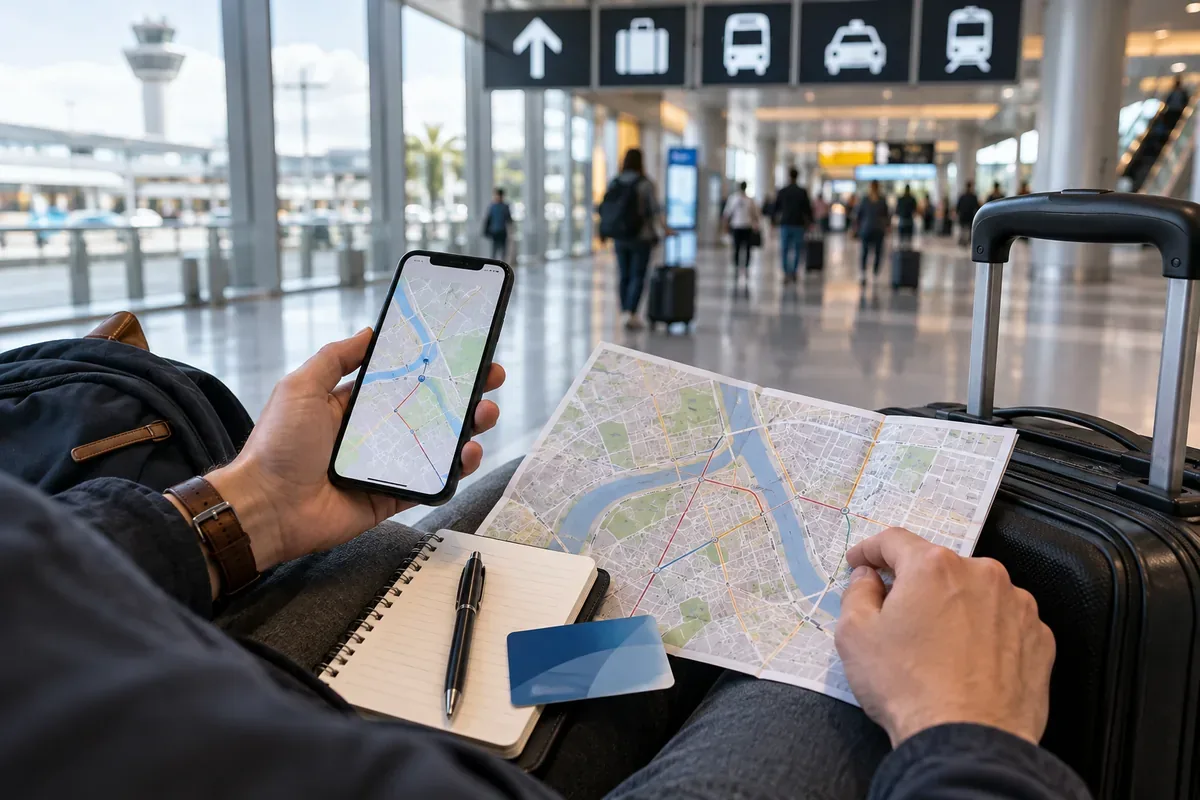
Check in ticket, confirmation, address, terminal map, neighbourhood map and itinerary to accommodation. Check that each file actually opens in airplane mode. A readable capture can complete an application without replacing it.
Step 4
Keep the information understandable
Note the address in the local handwriting when it is useful, the name of the neighborhood, a nearby station and the phone of the accommodation. These benchmarks allow you to ask for help even if the geolocation or connection does not work.
Step 5
Sharing resources
If you are travelling with more than one person, do not leave all confirmations on a single phone. A charged external battery, accessible cable and a small paper copy protect the arrival against an empty battery or lost device.
Step 6
Prepare for return
Find the terminal, departure schedule from the accommodation and the necessary margin. Check the disturbances announced the previous day. For a weather-dependent or uncommon route, provide a solution compatible with the check-in time limit.
Step 7
Putting into practice: One arrival after the last transport
Confirm an alternative and its price for the entire group. Ask for keys and late contact at the accommodation, then keep instructions and appointment point offline.
Putting comparison into practice
Test arrival when phone does not connect
Imagine an arrival without a mobile network. Your preparation should allow you to find the address, appointment and an alternative without opening an online email.
Educational example of preparation, without commercial offer or testimony. Adapt the situations to your journey and to the answers of the competent interlocutors.
On a small screen, scroll the table horizontally to read the three columns. On the keyboard, use the arrows after selecting the array.
| Situation to be considered | What it involves | Information to be obtained |
|---|---|---|
| Reserved transfer | The driver and the meeting place are identified. | Terminal registration, appointment, official number and procedure if no one is present. |
| Public transport | A journey to the address was chosen. | Keep the names of stops, matches and solution if the service is complete. |
| Arrival to accommodation | The reception may require separate instructions. | Keep access code or procedure securely and request alternate contact. |
How to use answers
Before departure, check that the downloaded documents are readable without connection. Share the arrival plan with the accompanying staff and plan who to contact if the flight or appointment changes.
Take the time of a last check
Before you validate, read the names, dates, locations, schedules and details of the services included. Do this check calmly on the final summary. An error identified before payment is usually much simpler to correct than after confirmation.
Always review the final conditions displayed by the claimant before paying and keep a copy of the summary. They only describe the reserved offer, the options for modification and the responsibilities of each party.
To be checked before departure
Official sources
These pages allow to update information that can evolve. Consult with the authorities of your destination and the bodies competent for your situation.
Frequently Asked Questions
The answers before deciding
What should be downloaded before a trip?
Tickets, confirmations, maps, addresses, itineraries and useful contacts. Open them once offline to check that they remain available.
How to choose between train, shuttle, bus and taxi?
Compare the price for the whole group, the door-to-door time, the schedules, the volume of luggage and the final walk. The best option depends on the hour and your autonomy.
What margin should be provided on arrival?
It depends on the terminal, the controls, the luggage and the frequency of the transfer. Avoid a tight match with the last available departure.
Is a screenshot enough offline?
It is a good help, but a downloaded map and complete files remain more flexible. Keep at least the address, route and contact of the accommodation.